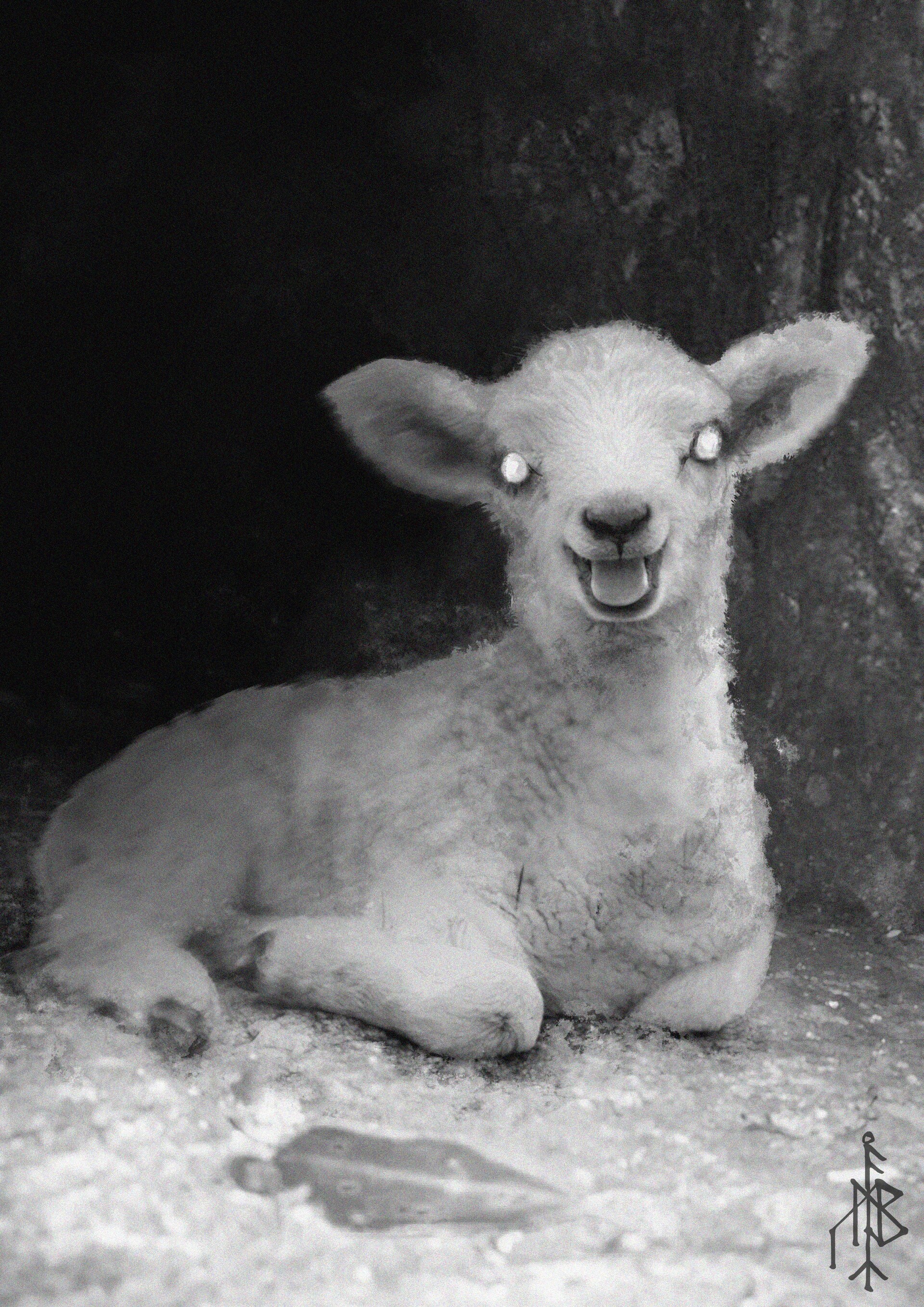
13 Le Tac inktober2020
Le Tac (in gascon lo tac) is a fantastic being, whose origin of its name remains unknown. It belongs to the legends and tales of Gascony, more particularly in the department of Landes and is often related to the drac, another creature of the same kind peculiar to Occitania.
This entity would be able to take various forms such as a basket, a lamb or a young goat and manifests itself at night in the woods or near the water, taking pleasure in whistling when someone approaches. His appearance, at first sight harmless, allows him to attract his victims, who, unsuspecting of the deceit, will want to carry the monster. As the person walks, the weight of the Tac increases until its wearer is exhausted or dead. After that, he starts to run away, laughing. The creature can sometimes take the form of a horse that causes the drowning of those who have the misfortune to ride it by throwing themselves into a river (cf Lou Drapé).
Back then, there were in the Landes large flat areas with high brush and marshes, sometimes swallowed up by the whims of the ocean and the floods of the rivers. Because of these unattractive landscapes, life was very difficult but it was also fertile ground for the popular imagination. The oral tradition passed from generation to generation, thus feeding the myths and legends of various creatures such as Tac or Cam-cruse.
---
Le Tac (en gascon lo tac) est un être fantastique, dont l’origine de son nom reste inconnue. Il appartient aux légendes et aux contes de la Gascogne, plus particulièrement dans le département des Landes et est souvent apparenté au drac, une autre créature du même genre propre à l’Occitanie.
Cette entité serait capable de prendre des formes variées comme un panier, un agneau ou un chevreau et se manifeste la nuit dans les bois ou près des points d’eau, prenant plaisir à siffler quand quelqu’un approche. Son apparence, à première vue inoffensive, lui permet ainsi d’attirer à lui ses victimes, qui, ne se doutant pas de la supercherie, voudront porter le monstre. À mesure que la personne marche, le poids du Tac augmente jusqu’à épuisement de son porteur et parfois son trépas. Après quoi, il s’enfuit en ricanant. La créature peut parfois prendre la forme d’un cheval qui cause la noyade de ceux qui ont le malheur de le monter en se jetant dans une rivière (cf Lou Drapé).
À l’époque, on trouvait dans les Landes de grandes étendues plates avec de hautes broussailles et des marais, parfois engloutie par les caprices de l’océan et les crues des rivières. En raison de ces paysages peu engageants, la vie était très difficile mais elle était aussi un terreau fertile pour l’imagination populaire. La tradition orale passait alors de génération en génération, alimentant ainsi les mythes et les légendes de diverses créatures comme le Tac ou la Came-cruse.
(Pour plus d’info : https://fr.wikipedia.org/wiki/Tac_(folklore) )